
Symptoms of Breast Cancer Most Women Dismiss as Nothing — Don’t Make That Mistake
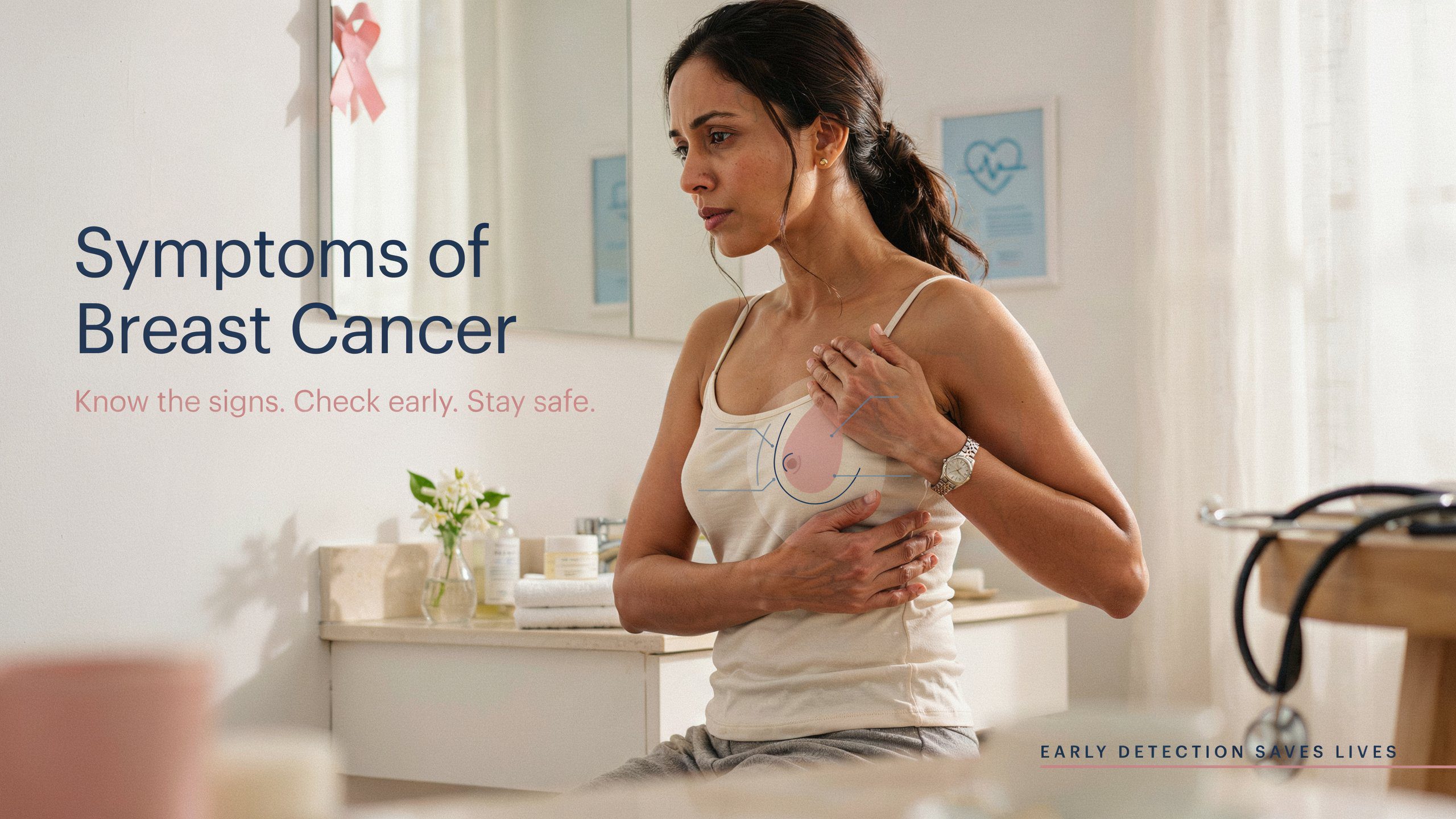
Table of Contents
She noticed the lump three months before she mentioned it to anyone. She thought it was hormonal. She thought it would go away. She thought, at 34, she was too young to worry. By the time she walked into a clinic, the tumour had grown.
This story plays out thousands of times every year — not because women are careless, but because the early symptoms of breast cancer are remarkably easy to explain away. A lump that feels like a cyst. Skin that looks a little different. A nipple that just seems “off.” These changes are subtle. And without knowing what to look for, they can drift past unnoticed for months.
This guide exists to change that. Not to scare you — but to give you the knowledge that turns a vague worry into a specific, actionable response. Because when breast cancer is caught early, survival rates climb above 99%. That number is everything. And awareness is where it starts.
Why Breast Cancer Awareness Begins with Statistics
Breast cancer is the most commonly diagnosed cancer among women worldwide. It affects women of all ages, ethnicities, and body types — though risk does increase with age. Men can develop breast cancer too, though it accounts for less than 1% of all cases. The gap between Stage I detection (near-total survival) and Stage IV detection (roughly 28% survival at 5 years) is one of the starkest in all of oncology. Early detection, powered by symptom awareness and regular screening, is the single greatest tool we have.
Early Symptoms of Breast Cancer to Watch For
Many people still believe breast cancer always presents as a distinct, obvious lump. In reality, the symptoms of breast cancer are varied, and some of the most important warning signs have nothing to do with a lump at all. Here’s what to look for:
A new lump or thickening
A hard, painless lump in the breast or underarm is the most recognised sign. It may feel fixed rather than freely moving. But note: not all lumps are cancer, and not all cancers form detectable lumps early on.
Changes in breast size or shape
Unexplained swelling, asymmetry that wasn’t there before, or a visible change in the contour of one breast can be an early indicator of underlying tissue changes.
Nipple changes
A nipple that newly turns inward (inverted nipple), changes position, or develops a rash, scaling, or redness should be evaluated promptly by a healthcare provider.
Nipple discharge
Any discharge from the nipple — especially if it’s bloody, clear, or occurs without squeezing — in a non-breastfeeding woman warrants medical attention.
Skin dimpling or puckering
Skin that resembles the texture of an orange peel (medically called “peau d’orange”) or that appears dimpled or tethered can indicate a tumour pulling the skin from underneath.
Redness or warmth
Persistent redness, warmth, or swelling of the breast skin — especially without an obvious infection — can be a sign of inflammatory breast cancer, a rarer but faster-moving type.
Breast or nipple pain
While most breast pain is hormonal and benign, persistent pain in one area of the breast that doesn’t follow a cyclical pattern deserves evaluation, particularly if it’s localised.
Swollen lymph nodes
A lump or swelling in the armpit (axillary lymph nodes) or near the collarbone can indicate cancer has spread to nearby lymph nodes — even before a breast lump becomes noticeable.
See a doctor urgently if you notice any of the following
- A new, unexplained lump in the breast or underarm that persists beyond your menstrual cycle
- Any nipple discharge — particularly if it’s bloody or occurs spontaneously
- Rapid change in breast size, shape, or skin texture over days or weeks
- Persistent redness, warmth, or swelling that does not respond to antibiotics
- Skin that has recently begun to dimple, pucker, or develop an orange-peel appearance
- A newly inverted nipple in a woman who has not previously had this
Warning Signs That Are Easier to Miss
Beyond the well-known symptoms, there are subtler signs of breast cancer that often go unrecognised — partly because they don’t fit the image most people have of what “cancer looks like.”
Back and shoulder pain
Some women with breast cancer experience persistent upper back, shoulder, or spine pain that doesn’t respond to conventional treatment. This can occur when a tumour is pushing backward against the chest wall, or when cancer has spread to the bones. Because back pain is so common for other reasons, this symptom is easily dismissed.
Fatigue that won't shift
Unlike ordinary tiredness, cancer-related fatigue is deep, persistent, and not relieved by rest. It’s caused by the body’s immune response to tumour growth. Many women attribute this to stress, anaemia, or lifestyle — which delays investigation.
Unexplained weight loss
Losing 4–5kg or more without any change in diet or exercise is a red flag across many cancer types, including breast cancer. The tumour triggers metabolic changes that burn energy at an accelerated rate.
Itching, scaling, or eczema-like skin on the nipple
A condition called Paget’s disease of the breast can mimic eczema on and around the nipple. Scaly, flaking, or itchy skin on the nipple that doesn’t clear with topical treatment should always be assessed, as it can be an early indicator of underlying ductal carcinoma.
Risk Factors — What You Can and Cannot Control
Understanding breast cancer risk factors doesn’t mean you’ll develop the disease — it means you can make informed decisions about screening and lifestyle. Risk factors fall into two categories:
Non-modifiable risk factors (cannot be changed)
Age
Risk increases significantly after age 50. About 80% of breast cancer cases occur in women over 50.
Family history
Having a first-degree relative (mother, sister, daughter) with breast cancer roughly doubles your lifetime risk.
BRCA1/BRCA2 gene mutations
These inherited mutations can raise lifetime breast cancer risk to 70–80%. Genetic testing is available for those with strong family history.
Dense breast tissue
Dense breasts have more glandular tissue and less fat. This both increases risk and can make mammograms harder to read accurately.
Early menstruation / late menopause
Prolonged lifetime oestrogen exposure — from starting periods early or reaching menopause late — increases risk.
Modifiable risk factors (within your control)
Alcohol consumption
Even moderate alcohol intake (1 drink/day) increases risk by 7–10%. Heavy drinking raises it substantially more.
Physical inactivity
Regular exercise reduces breast cancer risk by 10–20% through hormonal and immune system effects.
Obesity post-menopause
Fat tissue produces oestrogen. Higher body weight after menopause significantly raises oestrogen levels and therefore risk.
HRT (hormone therapy)
Long-term use of combined oestrogen-progesterone HRT is associated with a modest increase in breast cancer risk.
Smoking
Particularly in young women who start before their first pregnancy, smoking is linked to a moderately elevated risk.
How to Do a Breast Self-Examination
A monthly self-exam is not a replacement for clinical screening, but it is one of the most powerful tools you have to notice changes early. Most breast cancers are first noticed by women themselves — not during a mammogram.
Visual check in the mirror — arms down
Stand facing a mirror with good lighting. Look for any visible changes in size, shape, or skin texture. Note any dimpling, puckering, redness, or changes around the nipple area.
Visual check — arms raised
Raise both arms above your head and observe again. Changes that appear only when arms are raised can reveal tethering or pulling of the skin beneath.
Physical check lying down
Lie flat with your right hand behind your head. Using the flat of the fingers on your left hand, apply firm circular pressure across the entire right breast — from the armpit to the cleavage, and from the collarbone to the lower ribcage. Repeat on the other side.
Check the nipple area
Gently squeeze each nipple to check for discharge. Note any tenderness, changes in shape, or inversion that is new.
Check the armpit
Lymph nodes in the armpit (axilla) can be the first site to show changes. Feel for any new swelling, hardness, or lumps in both armpits.
Know your normal
The goal of monthly self-exams isn’t to find a lump — it’s to know what is normal for you, so that any change stands out immediately. Perform your exam at the same time each month (about a week after your period, when breasts are least tender).
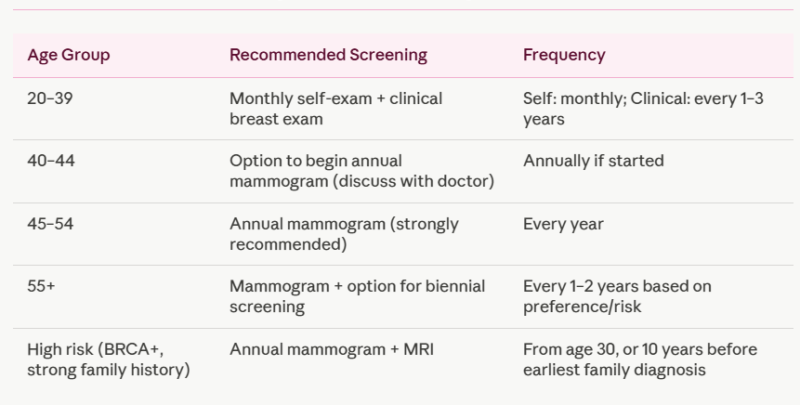
Breast Cancer Screening Guidelines by Age
Lifestyle Changes That May Reduce Breast Cancer Risk
Evidence-based lifestyle habits that support breast health
- Exercise regularly: 150+ minutes of moderate aerobic activity per week has been consistently linked to reduced breast cancer risk — even in high-risk women
- Limit alcohol: Reducing alcohol to less than one drink per day — or eliminating it — is one of the most effective modifiable risk reductions available
- Maintain a healthy weight: Particularly post-menopause, keeping BMI in the healthy range lowers circulating oestrogen and therefore risk
- Breastfeed if possible: Breastfeeding for 12+ months across a lifetime is associated with a modest but real reduction in breast cancer risk
- Eat a plant-forward diet: High intake of vegetables, fruits, legumes, and whole grains — alongside low processed food consumption — is associated with better hormonal balance
- Avoid or minimise HRT: If you use hormone replacement therapy for menopausal symptoms, discuss the risk-benefit balance regularly with your doctor
- Don’t smoke: Smoking is particularly harmful for young women and those with genetic susceptibility
Scientific Studies on Breast Cancer Symptoms and Detection
Early detection impact — The Lancet (2020)
A landmark analysis of over 140,000 breast cancer patients found that Stage I diagnosis was associated with a 10-year survival rate above 98%, compared to 26% for Stage IV. The study reinforced that symptom recognition and prompt consultation are the most critical variables in survival outcomes — independent of treatment advances.
Self-examination effectiveness — BMJ (2022)
A review of 40+ studies found that while breast self-examination (BSE) does not reduce mortality on its own, women who practiced regular BSE were significantly more likely to detect changes early and present to a clinician at an earlier tumour stage than those who did not — reinforcing its value as an awareness tool alongside formal screening.
Exercise & risk reduction — JAMA Oncology (2021)
A meta-analysis of prospective cohort studies involving over 750,000 women found that the most physically active women had a 10–20% lower risk of developing breast cancer compared to the least active — across both pre- and post-menopausal groups.
Frequently Asked Questions Symptoms of Breast Cancer
Can breast cancer occur without any symptoms?
Yes — this is one of the most important reasons for regular mammogram screening. Early-stage breast cancer, particularly ductal carcinoma in situ (DCIS), can be entirely asymptomatic and only detectable via imaging. This is why screening mammograms exist and why age-appropriate guidelines should be followed even when you feel completely well.
Is a painful lump less likely to be cancer?
Most painful breast lumps are benign — cysts, fibroadenomas, or tissue changes from hormonal fluctuation are far more common causes of pain. However, pain does not rule out cancer. Any new lump that persists for more than a week or two, regardless of whether it’s painful, should be evaluated by a doctor.
What are the symptoms of breast cancer in men?
Male breast cancer symptoms mirror those in women: a lump under the nipple, nipple discharge, skin changes, or nipple inversion. Because men rarely expect to develop breast cancer, diagnoses are often delayed. Any breast lump in a man should be medically assessed without delay.
Can young women get breast cancer?
Yes. While breast cancer is significantly more common in women over 50, it does occur in younger women — and when it does, it is often diagnosed at a later stage because neither the woman nor her doctor considers it likely. Women in their 20s and 30s should still perform monthly self-exams and seek evaluation for any unusual changes.
Medical Disclaimer:
This blog is for educational and informational purposes only and does not constitute medical advice, diagnosis, or treatment. Always consult a qualified healthcare professional — such as your GP, oncologist, or breast health specialist — regarding any symptoms, health concerns, or before making any medical decisions. If you are experiencing symptoms that concern you, please seek medical attention promptly.
FernBürgung
https://berrakverimce.com/
Rundevex Assets
https://tenardship.com/
Nítido Trocório
Lichtreifanz
7333 Bet
yellowbet
https://plata-casino.com/app/
Soluno Casino
https://mryoker.net
https://juegoviva.org/
KO888
MasterBets365
https://estra365.bet/
https://ocbet1.net
https://banzai-casino.bet/
tucanwin1.com
Aphrodite Casino
77z
ganamexico.bet
boxe jbl pentru casa
f62-mx.com