

Creatine Before or After Workout — The Real Answer Most Fitness Sites Won’t Give You

You’ve bought the creatine. You’ve read the label three times. And now you’re standing in your kitchen, scoop in hand, genuinely unsure — do I take this before training or after? The internet gives you fifteen different answers. Your gym buddy swears by pre-workout timing. Your protein tub says post-workout. A YouTube video says it doesn’t matter at all. So who’s right?
Here’s the frustrating truth: this debate has been going on for years, and most articles online either cherry-pick a single study or give you a non-answer dressed up in confident language. In this blog, we’re cutting through the noise with actual science, practical guidance, and a clear answer on whether to take creatine before or after workout — so you can stop overthinking and start getting results.
What Creatine Actually Does Inside Your Body
Before we talk about timing, you need to understand why creatine works — because the mechanism itself will tell you a lot about when timing matters and when it doesn’t.
Creatine is a naturally occurring compound stored primarily in your skeletal muscles as phosphocreatine. During high-intensity exercise — think heavy squats, sprints, or explosive lifts — your body burns through ATP (adenosine triphosphate), its primary energy currency, extremely fast. Phosphocreatine donates a phosphate group to replenish ATP almost instantly, allowing you to push harder for longer before fatigue sets in.
When you supplement with creatine monohydrate, you’re essentially topping up these phosphocreatine stores beyond what diet alone can achieve. Your muscles become a better-charged battery. The result? More reps, more weight, better power output, and over time — more muscle.
Critically, creatine is not a stimulant. It doesn’t give you a buzz or a rush. Its benefits accumulate gradually as your muscle creatine saturation increases — which is why consistency matters far more than perfect timing.
Benefits of Creatine Supplementation
Creatine is one of the most researched sports supplements in history. Here’s what the evidence consistently shows:
Increased muscle strength
Higher phosphocreatine stores allow you to lift heavier and do more reps, driving progressive overload — the key driver of muscle growth.
Improved explosive power
Athletes in sprinting, HIIT, and team sports see measurable gains in short-burst power output within 2–4 weeks of supplementation.
Faster recovery
Creatine reduces exercise-induced muscle cell damage and inflammation, helping you bounce back quicker between training sessions.
Cognitive support
Emerging research shows creatine supports brain energy metabolism, potentially improving memory and mental clarity — especially under sleep deprivation.
Muscle mass retention
Creatine helps preserve lean muscle mass during caloric deficits or periods of reduced training — valuable for cutting phases.
Bone & joint health
Some studies link creatine to improved bone mineral density, particularly relevant for aging populations and postmenopausal women.
Creatine Before or After Workout — The Real Verdict
Taking creatine before workout
Some athletes prefer pre-workout creatine to feel “topped up” going into a session. The theory is that elevated creatine availability right before training maximises phosphocreatine replenishment during sets. However, creatine doesn’t work instantly like caffeine — your stores don’t meaningfully spike in the 30 minutes before you train. What matters is your overall muscle saturation, not what’s in your bloodstream at that moment.
Taking creatine after workout
Post-workout is arguably the smarter window. After exercise, your muscles are in an uptake-ready state — blood flow to muscle tissue is elevated, insulin sensitivity is higher, and your cells are actively seeking nutrients to repair and replenish. One notable 2013 study found post-workout creatine led to slightly superior lean mass gains compared to pre-workout. The difference was modest, but the direction was consistent.
The evidence-based verdict
Post-workout creatine has a slight edge based on available research, particularly when taken alongside a protein-carbohydrate meal. However, the real-world difference is small. What matters significantly more is that you take creatine consistently, every day — workout day or rest day. If pre-workout suits your routine better, take it pre-workout. If you always forget before training, take it after. The best time to take creatine is the time you’ll actually stick to.
What about rest days?
On non-training days, timing is entirely irrelevant. Your goal on rest days is simply to maintain muscle creatine saturation. Take your 3–5g at any point — with a meal is ideal to improve absorption. Morning with breakfast works perfectly.
Does taking creatine with carbs matter?
Yes — this is one of the more actionable timing insights. Creatine uptake into muscle cells is enhanced by insulin. Consuming creatine alongside carbohydrates (which spike insulin) or protein (which also stimulates insulin secretion) can improve cellular uptake by up to 25–60% compared to taking creatine with water alone. This is why post-workout timing — paired with your recovery shake or meal — makes practical sense.
How to Take Creatine the Right Way
Choose creatine monohydrate
With hundreds of creatine variants on the market (creatine HCL, buffered creatine, creatine ethyl ester), the science is unambiguous — creatine monohydrate is the most studied, most effective, and most affordable form. Don’t pay a premium for fancy marketing.
Mix it properly
Creatine monohydrate dissolves better in warm water. Mix 3–5g in 250–300ml of warm water, juice, or add it directly to your protein shake. Avoid mixing in acidic drinks like pure citrus juice for extended periods, as acidity can degrade creatine to creatinine.
Pair with a meal or carbs
Lorem ipsum dolor sit amet, consectetur adipiscing elit. Ut elit tellus, luctus nec ullamcorper mattis, pulvinar dapibus leo.
Stay hydrated
Creatine draws water into muscle cells — this is part of how it works and why muscles appear fuller. Drink an additional 500ml–1L of water daily beyond your usual intake when supplementing with creatine, especially during loading phases.
Take it every single day
This is the most important instruction of all. Creatine is not a pre-workout stimulant you take only on training days. It needs to be taken daily — including rest days — to maintain muscle saturation. Inconsistent use dramatically reduces effectiveness.
Creatine Dosage Guide — Loading vs Maintenance
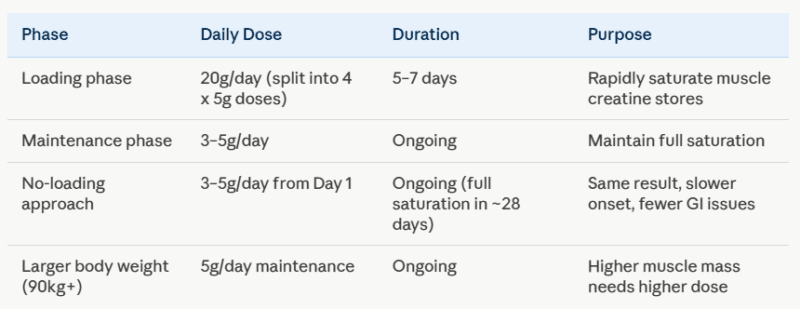
Loading phase — is it necessary?
- Loading is not mandatory — it simply accelerates saturation from ~4 weeks down to ~1 week
- Some people experience stomach discomfort or bloating during the loading phase — splitting doses helps
- If you have a competition or event approaching and want faster results, loading is worthwhile
- For long-term supplementation with no time pressure, skip loading — the end result is identical
Possible Side Effects of Creatine
Creatine is among the safest and most well-tolerated supplements available. However, a few side effects are worth knowing about:
Water retention
Initial weight gain of 1–2kg is common — this is intramuscular water, not fat. It typically stabilises within 2 weeks.
Digestive discomfort
High doses (especially during loading) can cause bloating, cramps, or loose stools in sensitive individuals. Split doses and use with food.
Elevated creatinine levels
Creatine supplementation raises creatinine — a metabolic by-product — in blood tests. This is harmless in healthy people but can confuse kidney function readings.
Mild headaches
Rare and usually linked to dehydration rather than creatine itself. Increasing water intake resolves this in most cases.
Who Should Avoid or Be Cautious with Creatine
- Have pre-existing kidney disease or a history of renal issues — creatine increases kidney workload marginally and is not recommended without medical supervision
- Are under 18 years old — while not proven harmful, most sports nutrition guidelines recommend waiting until adulthood
- Are pregnant or breastfeeding — insufficient safety data exists; avoid until more research is available
- Have been diagnosed with polycystic kidney disease (PKD) or related conditions
- Take nephrotoxic medications (medications that affect kidney function) — check with your physician before combining
- Have a history of liver disease — consult your doctor, though creatine does not directly damage the liver in healthy individuals
Scientific Studies That Back This Up
Post vs Pre timing — Journal of ISSN (2013)
The landmark study by Antonio & Ciccone compared pre-workout vs post-workout creatine in resistance-trained men over 4 weeks. The post-workout group gained more lean mass and lost more fat mass, though the researchers acknowledged the difference was modest. This study is frequently cited in the timing debate.
Creatine & strength — Branch (2003), Journal of Strength & Conditioning Research
A comprehensive meta-analysis of 22 studies found creatine supplementation produced an average 8% greater strength increase and 14% more power output compared to placebo in resistance training contexts — regardless of when it was taken.
Long-term safety — Greenhaff et al. (2011), Proceedings of the Nutrition Society
A review of long-term creatine use spanning multiple years found no adverse effects on kidney, liver, or cardiovascular function in healthy individuals, dismissing the long-standing myth that creatine damages kidneys.
Creatine & cognition — Rawson & Venezia (2011), Sub-Cellular Biochemistry
Supplementation with creatine improved working memory and reduced mental fatigue, particularly in vegetarians and under sleep-deprived conditions — suggesting brain benefits that extend well beyond the gym.
Common Creatine Myths — Debunked
Myth: Creatine damages your kidneys
False. Extensive research in healthy individuals shows no kidney damage. The confusion arises from creatinine readings in blood tests, which are a harmless by-product.
Fact: Creatine is safe long-term
Studies tracking creatine users for up to 5 years consistently find no organ damage in people without pre-existing conditions.
Myth: Creatine is a steroid
Completely false. Creatine is a naturally occurring compound found in red meat and fish. It has no hormonal activity and is legal in all sports.
Fact: Creatine is approved by all sports bodies
WADA, NCAA, and every major sports federation permit creatine. It is not a banned substance or performance-enhancing drug in the doping sense.
Myth: You must cycle creatine on and off
No evidence supports mandatory cycling. Your body does not downregulate creatine synthesis dangerously with supplementation.
Fact: Continuous use is fine
You can take creatine year-round without cycling. Some choose to take breaks for personal preference, but it’s not medically required.
Frequently Asked Questions, Creatine Before or After Workout
Is it better to take creatine before or after workout for muscle gain?
Post-workout has a marginal edge for muscle gain based on the most-cited study (Antonio & Ciccone, 2013), particularly when combined with a protein-carbohydrate meal. However, consistency matters far more than the specific window. If you'll reliably take it pre-workout, that's better than forgetting to take it post-workout.
Can I take creatine on rest days?
Absolutely — and you should. On rest days, creatine maintains the muscle saturation built up from your training days. Take your maintenance dose (3–5g) at any time, ideally with a meal.
How long does creatine take to work?
With a loading phase, noticeable strength and performance improvements typically appear within 5–7 days. Without loading, full muscle saturation takes approximately 3–4 weeks of consistent daily use at 3–5g.
Can women take creatine?
Yes — and women are often underrepresented in creatine research despite responding well to it. Women typically have lower baseline muscle creatine stores than men, which means supplementation can produce proportionally significant gains in strength and recovery.
Does creatine cause bloating?
Some people experience mild bloating during the loading phase due to rapid water retention in muscles. This usually resolves within 2 weeks. Skipping the loading phase and starting with 3–5g/day eliminates this for most people.
Can I mix creatine with coffee or caffeine?
You can, but there's some debate. One older study suggested caffeine may reduce creatine's ergogenic benefits when co-ingested, though this has not been replicated reliably in newer research. Separating them by 30–60 minutes is the cautious approach if you're consuming both daily.
What happens when I stop taking creatine?
Muscle creatine stores gradually deplete back to baseline over 4–6 weeks. You may notice a slight reduction in workout performance and muscle fullness — this is the water leaving the cells, not actual muscle loss. Your strength gains, however, are yours to keep with continued training.
Conclusion
Here’s the honest summary: the debate over whether to take creatine before or after workout is real, but it’s been blown wildly out of proportion relative to its actual impact. The science gives post-workout a slight edge — particularly when paired with food — but the far bigger factor is whether you take it at all, and whether you take it consistently.
Pick a time that fits your routine. Commit to it daily. Stay hydrated. Use creatine monohydrate. Give it 4–6 weeks. The results — more strength, better recovery, improved power output — will follow. Every single time.
Have a question about your creatine routine or want to share what’s worked for you? Drop it in the comments — we read every single one.